Earlier in this series, we introduced Ariadne, a framework to help nonprofit leaders add more focus and strategic thinking to their plans. Next up: how to navigate the maze with your board, not for them.
The Two Big Buy-In Traps
When I conduct discovery interviews at the start of strategy engagements, I hear the same frustrations from nonprofit executives again and again:
- "Our board doesn't engage with our strategy."
- "They approved the plan, but they don't really own it."
- "I need their support, but every strategic planning meeting turns into wordsmithing the mission statement for three hours."
The recurring theme is that the executive staff want and need strategic input they aren’t getting. And the recurring dilemma is that, to educate the board to get that input, the executives provide the board with more detail, which ironically leads the board further into the weeds.
Here's the uncomfortable truth: input is a process, not an outcome. If your board isn't engaged with strategy, it's probably because you're involving them in the wrong parts—or not involving them at all.
Many leaders fall into one of two traps in the planning process:
The Approval Trap: Staff builds the strategic plan, presents it to the board for approval, then wonders why there's no ownership. The board rubber-stamps it because they weren't part of creating it, and because they want to support the staff’s decisions. Six months later, when priorities shift or hard choices emerge, the board questions everything because they never really understood the thread connecting your choices.
The Endless Input Trap: The board gets involved in everything—debating word choices, rewriting paragraphs, weighing in on operational details, trying to build consensus on execution tactics. Everyone's exhausted, nothing moves forward, and the "strategy" ends up as a laundry list of projects or a watered-down compromise that makes no real choices.
And even when you find a way to constructively engage the board, it’s often difficult to go beyond vague affirmation–"great work, keep going"–and patronizing pats on the head—“this is good work for an organization with your resources." Gee, thanks!
Neither response helps you navigate the maze. One offers no substance. The other undermines your leadership.
The problem isn't that boards don't care about strategy. It's that we haven't been clear about how to involve them and what we actually need from them.
Following the Thread
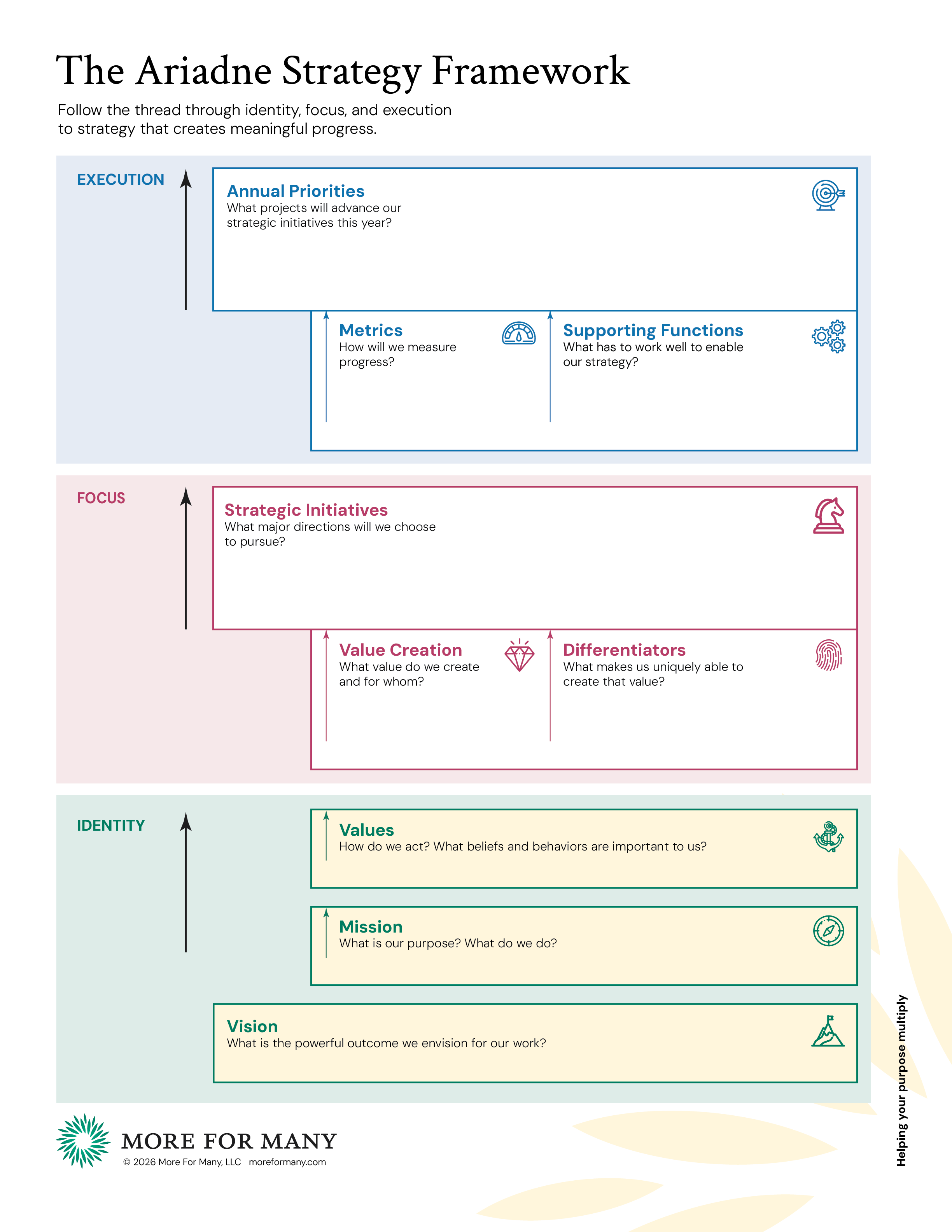
The Ariadne framework we introduced recently can help you decide when and how to involve your board.
Remember the story: Ariadne (pronounced eh·ree·AD·nee) gave Theseus the thread to navigate the labyrinth. She didn't run through the maze for him, or map every turn to take. Instead, she gave him a method to find his way—and to find his way back when he took a wrong turn.
Download the complete guide to the Ariadne Strategy Framework ->
In the same way, you can give your board a clear thread showing which parts they should help navigate, and which parts staff should lead.
Think of it as defining lanes. When everyone knows their lane, collaboration gets easier. When the lanes blur, you get either disengagement or overreach.
Here's how it can work.
Layer 1: Identity (Vision, Mission, Values)
Role: Board and staff co-create
This is not only about long-term governance; this is defining the culture of the organization for years if not decades. The board should be involved in defining who you are and what you aspire to. Vision, mission, and values aren't only staff decisions—they're organizational decisions that require board involvement.
This is where you want the board debating language, because this language defines your organization's reason for being and should set its strategic context for years to come. Your mission sets the direction, and your vision sets your intended outcome. It's where you start and where you're trying to end up on the other side.
Layer 2: Focus (Value Creation, Differentiators, Strategic Initiatives)
Board role: Staff leads, board validates
This is where most boards should spend their strategic energy, and where most boards need more development.
The Focus layer is about understanding your landscape and making deliberate choices about where you'll compete and what makes you different. This is the hard work of navigating the maze. It requires understanding the terrain so that you can choose which paths to take.
Board members bring an invaluable perspective here because they see things staff can't:
- Donor conversations that reveal shifting priorities
- Comparisons to peer organizations ("Here's what I'm seeing at other nonprofits...")
- Network connections and emerging partnerships
- Macro forces affecting the sector
But here's the critical distinction: The board helps map the maze. Staff should recommend which path to take.
Your board doesn't need to decide which three or four Strategic Initiatives to pursue, but they should deeply understand and challenge the thinking behind them. The board’s role is to help you understand the terrain so you can make informed choices. They should challenge your assumptions. They should ask hard questions about differentiation and focus.
Then, staff synthesizes what they heard, makes recommendations based on the feedback, and brings those choices back to the board for validation. Not approval—validation. There's a difference.
The board helps map the labyrinth. Staff chooses the best path through. Together, you hold the thread.
Layer 3: Execution (Annual Priorities, Metrics, Supporting Functions)
Roles: Staff builds, board monitors
The board shouldn't debate which projects make the list or how to measure progress on specific tactics. That's the operational work of moving through the maze day by day.
However, the board should ensure the Annual Priorities connect to your Strategic Initiatives and create forward progress. And critically, the board should hold the staff accountable for meeting the goals it asked the board to approve!
Similarly, the board should understand the metrics the staff is tracking, and whether the staff has the capacity and resources to execute.
The board role here is oversight: "Is this realistic? Does this connect back to our Focus? Do you have what you need? Are you following the thread, or have you taken a wrong turn?"
Start With The Framework
So how do you involve your board meaningfully in your work?
We recommend talking with the board in advance about what strategic planning framework you’ll use, whether it is More For Many’s Ariadne Strategy Framework or something else.
Use it as a process map to say, “Here are the questions we’ll be considering, and here’s who will be involved at each stage.”
A framework like Ariadne won’t give you all the answers, but it will help structure the process and the discussions so they aren’t circular. A bit of time up front aligning roles and simply saying, “Here’s our playing field” will pay dividends in reduced frustration and more meaningful discussions.
This might seem too academic, but I’ve found that board members are eager for this type of training. At the start of strategic planning sessions, I’ll lead introductions to the planning framework that turn into long, engaging conversations, not because board members aren’t paying attention, but because they are invested and interested in learning more.
More than anything, outlining the framework up front accomplishes a few key steps in cultivating buy-in:
- It creates shared understanding before you make strategic choices together. Most board conflicts happen because people are operating from different mental models. The framework helps everyone see the same maze.
- It puts the board in its sweet spot. They're not editing sentences or debating tactics. They're bringing their expertise, networks, and external perspective to help you understand the full landscape.
- It prevents the platitudes/patronizing problem. When you ask specific questions—"What are constituents saying about our work?" or "Which peer organizations are gaining traction and why?"—you get substantive input instead of vague enthusiasm or corporate jargon imported from someone's day job.
This isn't consensus-driven. You're not trying to get everyone to agree on the strategy at this stage. You're gathering diverse perspectives, then you (the staff leadership) choose the path informed by what you learned.
The board's job is to challenge your thinking, validate your logic, and ultimately support the direction, because they helped you see the maze clearly and understand why you chose this path.
Alignment Through Partnership
When board members help assess the maze and the process, something shifts. They:
- Understand why certain choices matter because they were part of mapping the terrain.
- See their input reflected in the strategy. They may not necessarily see their exact recommendations, but they can see their perspective considered and addressed.
- Trust staff to execute because they co-created the foundation and can follow the thread from who you are to what you're doing.
Most importantly, buy-in isn't something you get at the end of the process. It's something you cultivate throughout by involving people in holding the thread together.
Your board doesn't need to run through the maze for you. But they need to help you see it clearly, hold the thread with you, and trust you to navigate it day by day.
Where To Start
If you're planning a strategic planning process in 2026, try this:
Don't start with a SWOT analysis or setting up a committee to rewrite your mission statement. Start by picking the planning framework you’ll use, and then aligning on the roles everyone will play.
Don't present a finished strategic plan for approval. This isn’t a fill-in-the-blank exercise. Involve your board in understanding the terrain, then bring them strategic choices informed by that assessment. Show them the thread.
Don't ask for buy-in. Cultivate it by making your board co-navigators of the strategy, not just approvers of the plan.
Want board alignment? Help them hold the thread with you.
Need help getting your board aligned on strategy? We facilitate strategic planning sessions that give boards a clear role without dragging them into the weeds. [Learn about our strategic planning services →]
This article is the fourth in our series Strategy For What’s Next, designed to help you create meaningful plans and excellent results in the year ahead. Read the other posts here.
Board alignment starts with a shared framework. Here's the complete guide.
Download Setting Better Strategy: An Introduction to the Ariadne Strategy Framework and give your team a framework they'll actually follow.

The Ariadne Strategy Framework: Why Nonprofit Strategic Plans Fail and How to Fix Them

The Strategy Problem Your Nonprofit's Operating System Can't Solve

No Comments Yet
Let us know what you think