
Over the last two parts of our Strategy For What’s Next series, we looked at taking stock and deciding what to stop. This week, we tackle the layer most nonprofit strategic plans miss: focus.
Navigating the Maze
Do you know the legend of Theseus and the Minotaur?
In the story, Theseus is the hero. He sails to Crete, enters the labyrinth, slays the Minotaur, and escapes. These are the pieces of the story that most of us know.
Few know the part about Ariadne.
Ariadne (pronounced eh·ree·AD·nee) was a princess trapped in her father's kingdom, a place built on human sacrifice, with a monster in the basement she didn't create. When Theseus arrived, it was Ariadne who gave him the way to survive. She gave him a ball of thread and a simple instruction: tie it at the entrance, unwind it as you go, and follow it back out.
Alas, as we tell the story now, Theseus is the hero, and the sword was the tool. But the thread, not the sword, was the solution. And Ariadne was the actual hero, for when Theseus escaped, so did she. (Later Theseus abandons her, but she has the last laugh when she marries the god Dionysus.)
Finding the Thread
There are dozens of strategic planning frameworks out there. Despite this, research shows that well over half of strategic plans fail to deliver meaningful results. (Sadly, a number of different studies have corroborated this finding.)
Why? Because most organizations approach strategy the way Theseus would have without Ariadne. They stand at the entrance of the maze, declare where they want to end up, and then charge straight into the labyrinth without a thread connecting their work.
In my experience, these failures typically fall into two extremes:
Too Fluffy: Plans focus on vision and values but lack clear choices about what makes your organization different, where you will focus resources, or what specific actions you will take to drive impact. Everyone feels inspired by the mission, but no one knows what to do differently on Monday. They're standing at the entrance of the maze, dreaming about where they could end up.
Too Tactical: Plans are lists of operational imperatives—do more, do better, keep going—without the focus, differentiation, and deliberate choices that define real strategy. They're work plans masquerading as strategic plans. They're running through the maze at full speed, without a clear idea of how to get where they want to be.
Here's what both extremes have in common: their strategic planning doesn't have a thread connecting who they are to what they are doing.
Working on Identity—vision, mission, values—can be exhilarating work. Aligning a team on these foundational questions requires time and conversation. And working on goals and metrics feels grounded and action-oriented. Perhaps that's why many teams mistakenly jump right to annual goals after they set the vision and values.
That's a huge mistake, because there's a maze to navigate in the middle. At More For Many, we call it the Focus layer.
The Focus layer is where real strategy lives. It answers questions like:
- What value do we create, and for whom?
- What makes us different from everyone else doing similar work?
- Where will we concentrate our resources to create the most impact?
- What are we choosing not to do?
Without straightforward answers to these questions, strategic plans are just a set of wish lists and task lists. Teams have a mission they believe in and goals they're chasing, but no obvious thread holding them together. So they stay busy without making progress.
Introducing Ariadne
Through helping clients close this gap, we've developed a strategic framework called Ariadne. In logic, the term "Ariadne's thread" describes any method of solving a problem while keeping track of where you've been, so you can find your way back if you hit a dead end.
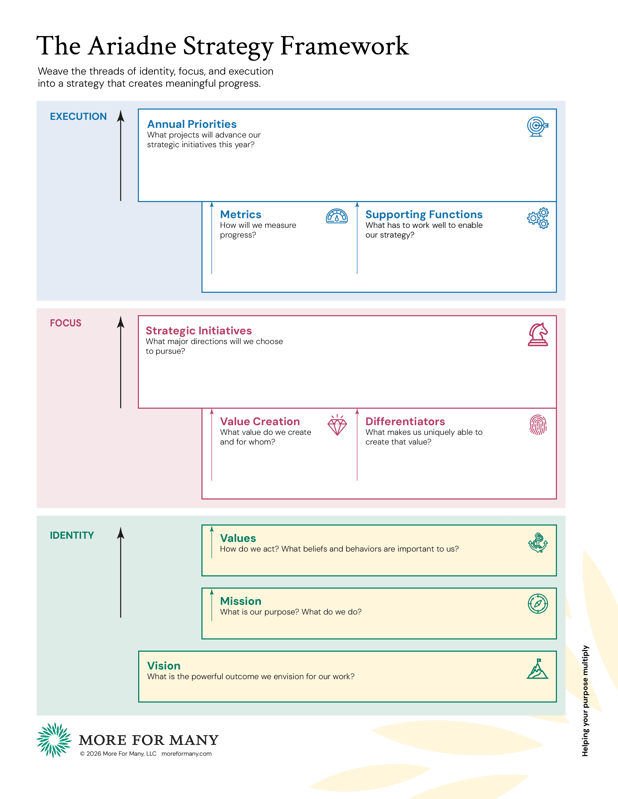
A good strategy should help you do the same thing. Your strategic plan should help you navigate your way through successes and challenges, and find your way back on track when you get lost. Ariadne weaves together three layers of Identity, Focus, and Execution so that every choice connects back to who you are and where you're going. If you take a wrong turn, you follow the thread back and adjust.
Download the complete guide to the Ariadne Strategy Framework ->
Layer 1: Identity — Who we are and what we aspire to
This is your foundation. Your mission, vision, and values describe your core identity. Most organizations have this layer in place—it's the starting point for any meaningful strategy work.
- Vision: What is the powerful outcome we envision for our work?
- Mission: What is our purpose? What do we do?
- Values: How do we act? What beliefs and behaviors are important to us?
Vision comes first because it directs everything that follows—it's where you're headed. Identity is relatively stable over years, even decades. It sets your direction, your culture, and your definition of success.
Layer 2: Focus — What makes us different and where we choose to compete
This is where real strategy happens, and where most plans fall short.
Focus answers three critical questions:
- Value Creation: What value do we create, and for whom? What are our constituents "hiring" us to do?
- Differentiators: What makes us uniquely able to create that value? Why do people choose us over alternatives?
- Strategic Initiatives: What major directions will we choose to pursue? Where will we invest to create the most impact?
The idea of trade-offs is inherent in the Focus layer. The term "trade-offs" can sound like strategy is about giving up. That's not the point.
Instead, the point is to bolster your sources of competitive advantage. Strategic success comes from being willing to cede some territory to lead in others. If you're trying to be everything to everyone, you're not setting strategy.
True Strategic Initiatives lean into trade-offs. They outline directional and substantial moves that may take years to complete and require significant investment and focus. To focus on an initiative that is truly significant, other projects have to be put off until later.
I frequently see plans that outline general intentions without choosing specific approaches to achieve them. The intentions sound directional and substantial, but they don’t help the organization move forward.
As an example, it is very common for me to see "diversify revenue" as a pillar listed in a strategic plan. But think about that phrase for a moment. Is "diversify revenue" a strategy or an intended outcome? The phrase doesn't explain how to accomplish the end state, who will do it, what to take on, and what to set aside. And yet, this line shows up in nearly every plan I work on.
Imagine asking a coach her strategy for winning a game and hearing her say, “Achieve victory.” Well, yes, achieving victory would help you win! But would that help her players make choices about what to do? Would that outline a set of techniques to work on in practice?
In the same way, you want a strategy that goes beyond, “Get out of maze.” You need a way of outlining which turns you’ll take, and why.
The Focus layer helps ground vague imperatives into directions your team can pursue. A strategic initiative to diversify revenue might be "Launch a set of paid services" or "Establish a legacy giving program." As you get specific about the value you create and how you're different, it becomes easier to see what you need to do to grow.
Layer 3: Execution — How we make it happen
The Execution layer is where plans become action:
- Annual Priorities: What projects will advance our strategic initiatives this year?
- Metrics: How will we measure progress?
- Supporting Functions: What has to work well to enable our strategy?
Your Execution layer should connect directly back to decisions you made in the Focus layer. You can easily do this by creating several Annual Priorities for each of the Strategic Initiatives, which ensures that everything ties together. Ask yourself, “On the path to this Strategic Initiative, what will we do this year?”
Don’t write a long list of goals that are disconnected from your value creation, differentiation, and long-term direction. If you find that you really want to do something that isn’t mentioned in your Focus layer, that might be the sign you need to back up, clarify where you wanted to go, and take a different turn.
Where to Start
Think of strategic planning as finding your way forward, not running at top speed. You start with where you want to end up (Vision), then thread your way through Identity, Focus, and Execution. Each layer connects to the others, and that's what keeps you from getting lost.
When an initiative doesn't trace back to your differentiators, or a metric doesn't measure what matters, follow the thread back and adjust. Strategy isn't a document you write as quickly as you can. It's a thread you check at every turn.
If your strategic plan feels too vague or too operational, start by asking these core Focus questions:
- What value do we create, and for whom? What is the tangible, immediate value your constituents would miss if you didn't exist?
- What makes us different? Challenge yourself to go beyond stock answers like "we care more" or "our people." Every organization can say it has great people. What are the actual reasons your constituents choose you instead of other organizations?
- What 3-5 strategic initiatives will drive the most impact? What are the few things that, if you do them now, will matter most in three years?
As you dive into this layer, you'll find it can be enlightening and energizing. Like all great discussions, it's better with a group, so collect the people you most trust, grab a blank flip chart, and focus on Focus.
Need help in applying focus to your nonprofit's strategic plan? We work with nonprofit leadership teams and boards to build strategic plans that create real focus and lasting results. Learn more about our strategic planning services →
This article is the third in our series Strategy For What’s Next, designed to help you create meaningful plans and excellent results in the year ahead. Read the first two posts here.
Download Setting Better Strategy: An Introduction to the Ariadne Strategy Framework and give your team a framework they'll actually follow.

The Free Guide to the Ariadne Strategy Framework Is Here

Preserving Your Inspiration

No Comments Yet
Let us know what you think