Strategy isn't just about what you'll do. It's about who you'll need to do it with.
In this final post in the Strategy For What's Next series, we turn from planning to people—because your strategic initiatives for the next three to five years will require relationships, partnerships, and community connections you don't have yet.
The question is whether you're building them now, or planning to figure it out later.
You Can't Build Community When You're Desperate for One
A mentor of mine used to say that preparing for retirement takes ten years. Not financially—relationally. It takes that much time to cultivate the friendships, hobbies, and sense of purpose outside of work that you need to live an engaged, vibrant life. You can't manufacture those the week after your farewell party.
Community works the same way.
Over the last twelve months, I've watched organizations scramble as federal funding got shaky, major donors got distracted by other worthy causes, and reliable revenue streams dried up. The ones that weathered it best had something the others didn't: a base of people who actually care about them.
By "base of people who actually care," I don't mean a CRM full of lapsed donors. I mean real community: people who show up, who give, who recruit their friends, who stick around when things get hard.
You can't spin that up in a crisis. You have to build it before the crisis comes.
Strategy Should Surface Who, Not Just What
A thoughtful strategic planning process should challenge you to think beyond tactics and timelines. It should surface not just what you're going to do, but who you'll need to do it with.
That's a different question. It moves the conversation from "what's our program plan?" to "what relationships do we need to build over the next few years to make this work?"
For some organizations, that means partnerships with other nonprofits. For others, it means corporate sponsors, academic institutions, or government agencies.
Using an intentional planning framework, like More For Many's Ariadne process, will help you slow down to consider your set of key stakeholders, from donors to sponsors to constituents to beneficiaries.
But for most organizations—especially those whose mission depends on public engagement—at some point, it will mean building a grassroots community of people who care.
And that brings us to one of the most misunderstood tools in the nonprofit toolkit.
What Peer-to-Peer Actually Is
In my fall strategic planning engagements, I had nearly the same conversation with two different organizations. Different missions, different leaders, different cities, but the same question was on the table:
Why are we still doing our peer-to-peer fundraising event?
In both cases, the event was a walk. Twenty years ago, fundraising walks felt essential for organizations seeking to mobilize engagement at scale. But times change, tactics evolve, and now peer-to-peer feels expensive. Leadership sees declining participation, flat revenue, and a line item that's hard to justify when everything else is getting cut.
But here's what I've noticed: the organizations asking "Why are we still doing this?" are often the same ones saying "we need to build community" and "we have to diversify revenue" and "we're too dependent on a few funding sources."
Last month, I was comparing notes with Jillian Schranz and Molly Fast from Event 360, a firm that's been deep in peer-to-peer fundraising for decades. It's also a company that's close to my heart–I helped co-found the company back in 2002, and served as its CEO for 11 years.
I mentioned how jarring it is to hear "our peer-to-peer is too expensive" in the same breath as "we need to build community."
Jillian sighed and then put it well: "The expense of peer-to-peer is obviously very measurable. But the tactics, approach, and humanness of it are not as easy to track as digital or email conversions. But you really notice it's gone when you lose it."
"Most nonprofits are good at giving people the tools to fundraise," Molly added. "But they don't actually teach people how to fundraise."
That landed with me. Organizations hand someone a fundraising page and say "go." Then they wonder why results are flat.
But the real issue runs deeper than tactics. Many organizations treat peer-to-peer events as a revenue channel, not an engagement strategy. They see a walk as a cost center, with tents, permits, t-shirts, staff time, instead of seeing it as the one moment all year when regular people get to do something with their connection to the cause.
At the end of the day, your mission can only be expressed experientially. And further, it means more when it's expressed by the people it matters most to.
That's what peer-to-peer is. It's not a collection of bibs and tents. It's a collection of people who care about you, doing something together, and inviting others into it.
If you're not seeing that return, the problem probably isn't the event. It's that no one ever decided why you're doing it.
Building Infrastructure, Not Just Events
Jillian shared an example that stuck with me. One organization—serving a cause that carries real stigma—was struggling to build local presence. As a national organization without an ongoing base in their event markets, one event per year was not enough to build a connected community.
So, at the encouragement of Event 360, they tried something different. They invited local organizations to become a beneficiary team. Those selected teams would recruit, fundraise, and participate—and keep a share of what they raised. The national organization got community presence without the footprint cost. The local organizations got fundraising coaching, funding, and visibility. The participants got to support something that mattered to them in a way that felt real.
The results were impressive. This group of teams met their fundraising minimum, and most exceeded it significantly. The teams with a strong local presence became the largest in their markets.
See the difference? The national organization went from running an event to investing in long-term infrastructure.
The Long Game
Here's what makes this hard: building community doesn't show ROI in year one. Maybe not in year two either. It's a long game, and long games are tough to defend when budgets are tight and boards want results now.
But consider the alternative.
I'm working with organizations right now that spent the last decade focused on bolstering their institutional funding. Smart, efficient, and high-return. Until … it wasn't.
Now they're scrambling to find individual donors, to enlist grassroots support, to create the community fabric they assumed would just be there.
But it's not there, because no one built it.
The organizations that invested in community five years ago—even when it was hard to justify, even when the ROI was murky—are the ones with options today. They have people who answer the phone. People who give $50 when asked. People who show up.
A Framework for Thinking About This
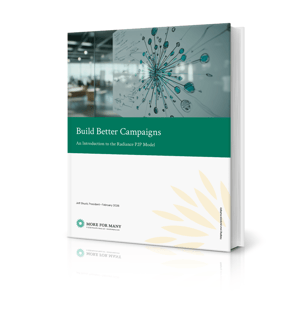
At More For Many, we've been developing a model for how peer-to-peer programs can build community and not just revenue. We call it the P2P Radiance Model, and it maps the journey from organizational commitment through network growth. We'll be sharing more about it in the lead-up to the spring peer-to-peer event season.
But here's the core idea: peer-to-peer isn't only a fundraising tactic. It's a community strategy with fundraising outcomes. When you flip that framing, the ROI question changes.
So if you're heading into planning season asking "should we keep doing this event?"—slow down. That might be the wrong question.
Better questions:
-
Do we have a strategy for building community, or are we just showing up to collect money?
-
Are we teaching people how to fundraise, or just handing them tools and hoping?
-
What would it look like to treat this event as community infrastructure instead of a cost center?
-
If we cut this, what's our plan for building community some other way?
The organizations that will be strongest in ten years are the ones making community investments now—when it's hard, when the ROI is uncertain, when it would be easier to just cut the line item and move on.
It's not a fundraising decision or an event production decision. It's a strategy decision.
And strategy is about what you build, not just what you cut.
Jillian Schranz and Molly Fast are part of the peer-to-peer strategy team at Event 360, which provides event production, fundraising training, and program development for nonprofit organizations. At More For Many, we write about the tools we use and people who inspire us. We weren't paid to write this article.
What's your strategy for building community in 2026? [Contact Us]



No Comments Yet
Let us know what you think