Beyond SWOT: A Better Way to Scan Your Landscape
It Was Over Before It Started
It Looked So Promising
Does this sound familiar?
Your leadership team decides it’s time for a new strategic plan. You clear a day on the calendar — “no, let’s make it two,” someone says. Really commit.
You want to make sure you “drive to action,” so you ask everyone to prepare their initiatives for the new year in advance.
You gather your board and senior staff in a conference room. You spend the first 45 minutes on a quick SWOT analysis, but "everyone knows our space," so you hurry that along to get to the real stuff. Slides are shown. Ideas are presented; questions are answered. You don’t quite get to everything, but you leave feeling good about the result. You’re running out of time before you get to the follow-up, so someone takes on the action item of typing up all the flip charts (hey, AI can do it, right?) and circulating the commitments.
Six months later: the plan is sitting on a shared drive that no one opens. It’s been revised a couple of times. Is v3 or v4a the current version we’re supposed to use?
The first few weeks after the retreat were promising, but the outside world caught up with a vengeance. Your team is doing roughly the same work they were doing before, but seems busier than ever, because they now spend a couple of hours a month sifting through a long list of incomplete “strategic pillars.”
At the last board meeting, someone asked, “Why don’t we ever look at the strategic plan?”
Failure to Launch
Research suggests that anywhere from 60% to 90% of strategic plans never fully launch. That’s not exactly a glowing endorsement of strategic planning!
Is it because the wrong solutions are chosen? Or that the plans aren’t implemented well? Both can be true, but in our experience, the real problem starts earlier: the leaders never agreed on the core issues to address in the first place.
Sometimes, everyone assumes they see the situation the same way. Sometimes, it isn’t safe to share conflicting views, so differences get explained away. But often, like in our example above, the team, in their eagerness to get to solutions, steps over the problem diagnosis.
You can’t execute your way out of a diagnostic problem.
If the board thinks the organization has a funding diversification problem, the executive director thinks it is a donor engagement problem, and the development team sees it as a brand awareness problem, the result will be a mishmash of “imperatives” and “initiatives” that add to everyone’s workload but don’t connect to growth. The board, executive director, and development team can all be right about the symptoms but wrong about the cause, and without some careful thought, they’ll build a plan around three different problems, call it a strategy, and then wonder why nothing changes.
What helps is slower, more thoughtful questions: What’s actually true about our internal capacity right now? What’s happening in our environment that we’re not talking about? And what’s on the horizon we haven’t prepared for?
You need a framework that can help you answer the core planning question: Do we agree on the problem?
That’s what this page is about.
Going Deeper
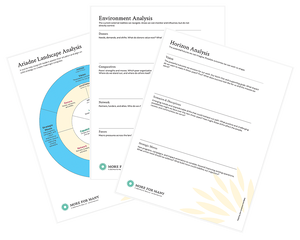
- Download the free Landscape Analysis worksheets to use in your next planning process.
- The Ariadne Strategy Framework. Once you scan your landscape, use our approach to building strategic plans that connect identity, focus, and execution.
- Subscribe to our newsletter. Practical tools and fresh ideas, delivered monthly.
The Problem With SWOT
If getting on the same page about the landscape is the issue, why not just use SWOT analysis?
If you've ever been part of a strategic planning process, chances are good you've been in a room with a whiteboard divided into four quadrants: Strengths, Weaknesses, Opportunities, Threats.
SWOT has been the default starting point for strategic planning since the 1960s. You can find it in MBA programs, board retreats, grant applications, and consultant slide decks. It’s simple, it’s familiar, and it’s everywhere.
But we stopped using SWOT in our client engagements years ago, and we’d encourage you to consider doing the same.
Here’s why.
SWOT is a flat list, not a framework. SWOT captures information, but it doesn’t organize it in a way that leads to action. You end up with a grid of sticky notes — some insightful, some obvious, some contradictory — and no clear sense of what to do with them. We’ve seen SWOT analyses produce 40 or 50 items. Try turning that into a focused strategy!
It conflates internal and external. Strengths and weaknesses are internal. Opportunities and threats are external. But the quadrant format treats them as if they exist on the same plane, even though they require fundamentally different responses. You plan and direct your internal reality. You monitor and influence your surroundings. Those are very different verbs.
It’s backward-looking. SWOT captures a snapshot of the present and the recent past. It doesn’t push you to think about the emerging trends, potential disruptions, scenarios that haven’t happened yet but could reshape your path.
It doesn’t distinguish between the important and the trivial. Everything gets equal weight. A critical gap in leadership capacity sits on the same list as “our website needs updating.” A seismic shift in funder priorities gets the same sticky note as “a nearby organization started a similar program.”
And perhaps most importantly: it doesn’t lead anywhere. SWOT is often the first step in a planning process, but there’s no inherent logic connecting it to the next step. What do you do with the information? How do you build on your strengths? How do you shore up your weaknesses? How does any of it inform your strategy? That gap between assessment and action is where most plans get lost.
None of this means SWOT is useless. It can work well as a quick temperature check or a warm-up exercise. But as the primary tool for understanding your landscape before making strategic decisions? We think you can do better.
The alternative frameworks — PESTLE (Political, Economic, Social, Technological, Legal, Environmental), SOAR (Strategies, Opportunities, Aspirations, Results), SKEPTIC, and others — each try to address some of these limitations. PESTLE is thorough but entirely external. SOAR is optimistic but skips the internal honest look. None were designed specifically for nonprofits. And none connect the assessment directly to a strategic planning process.
That’s what the Ariadne Landscape Analysis does.
Explore
- 50+ nonprofit strategic plan examples. Prosper Strategies has assembled an excellent collection of published strategic plans you can browse for inspiration.
- Explore our library of posts. Our Strategy For What's Next series will help you take stock before you plan.
The Ariadne Landscape Analysis
We developed the Ariadne Landscape Analysis as a companion to our Ariadne Strategy Framework. It’s designed to give nonprofit leaders a better way to assess their situation before they build their strategic plan.
The Landscape Analysis is built around a simple principle: the world your organization operates in has three distinct layers, and each one requires a different kind of attention.
In the model, we show this as three concentric rings:
Core is the innermost ring. It covers your internal reality — the values, capabilities, and gaps that you directly plan and control. This is your honest look in the mirror.
Environment is the middle ring. It covers the external realities you navigate — donors, comparatives, your network, and the macro forces shaping your sector. You can monitor and influence these areas, but you don't directly control them.
Horizon is the outermost ring. It covers the future you can envision — your vision, the scenarios and disruptions that could reshape your path, and the strategic moves that could redefine your trajectory. This is where you imagine and shape what's next.
The rings work from the inside out. You start with what you know and control, move to what you can see and influence, and then stretch to what you can imagine and pursue.
This matters because most planning processes get the sequence wrong. They start with vision (the outermost ring) and try to work inward. Or they jump straight to strategic initiatives without understanding the terrain. The result is a plan that's disconnected from reality — inspiring on paper, impossible to implement.
Why three layers instead of four quadrants? Because the relationship between what you control, what you influence, and what you envision is sequential and hierarchical. You can't assess your environment without understanding your core. You can't imagine your horizon without understanding your environment. The concentric structure makes that logic visual and intuitive.
It also mirrors the structure of the Ariadne Strategy Framework itself. Ariadne is built in three layers — Identity, Focus, and Execution — that move from who you are, to what you'll pursue, to how you'll do it. The Landscape Analysis uses the same three-layer logic to map the terrain you're planning against: internal reality, external environment, future possibility. Three rings of assessment feeding three layers of strategy.
In the following three chapters, we'll walk through each ring — what it contains, how to assess it, and the questions that unlock the most useful insights.
Get the Tools
- The "Strategy For What's Next" series. A 7-part series on strategic planning for nonprofits.
- Download the Landscape Analysis (PDF) to use in your next planning session.
- The Ariadne Strategy Framework. Then, turn your assessment insights into a strategic plan that works.
Exploring the Rings
The Landscape Analysis works best when you explore it interactively. Click each ring in the graphic above to see its elements, the questions behind them, and a reflection to bring back to your team.
Start at the center. Core asks what you plan and direct. Environment asks what you monitor and influence. Horizon asks what you imagine and shape.
The rings build on each other. You can’t honestly assess your environment without first understanding your core, and you can’t imagine a horizon without understanding the environment you’re moving through.
When you’re ready to run the analysis with your team, the downloadable worksheets give you space to capture your answers.
Download the Worksheets
Get the free printable Landscape Analysis worksheets to use for your team’s next strategic conversation.
How to Run the Analysis
The Landscape Analysis is designed to run as a facilitated conversation with a group of your trusted leaders. The worksheets give everyone a shared structure, and can help you both facilitate and participate if you'd like.
Who should be in the room? We recommend your senior team and a small group of key constituents. That might mean board members, key partners, and significant donors. Keep the group small enough that everyone can speak candidly, usually six to twelve people.
The Environment ring benefits most from outside perspectives — partners, board members, and donors often see donor shifts, peer moves, and macro forces that staff don’t. Invite the people who care, and who bring specific expertise to the topics you most need to discuss.
What to prepare. Share the worksheets in advance. It can help (but isn't always necessary) to gather a year or two of performance data (financial, programmatic, and fundraising reports) and distribute it along with any relevant sector reports. People should arrive informed, not surprised.
Time required. Plan about two to two-and-a-half hours total, or roughly 30 minutes each for Core, Environment, and Horizon, plus time to wrap up. You can absolutely go longer if the team has the appetite for it, but in our experience, it’s hard to keep people engaged for much more than that.
How to structure the conversation. Work from the inside out: Core first, then Environment, then Horizon. For each ring:
-
Ask each person to spend five minutes on individual reflection on the questions.
-
Then, break the full group into small groups of 3-4 people. Ask each small group to discuss their reactions in detail for 15 minutes.
- Finally, regroup as a large team and ask each group to report back.
- Do that process three times, once for the Core, then the Environment, and finally the Horizon.
Why this sequence? Individual reflection followed by small groups followed by group synthesis consistently produces richer results than jumping straight to open conversation. It prevents the team from converging on whatever the most senior person says first, and ensures everyone has a voice.
The most important rule. No solutions yet. The Landscape Analysis is about understanding, not fixing. When someone says "we should...," redirect them: "We're mapping the terrain right now. We'll choose the path later."
At this stage, the goal isn't a plan. The plan comes next. Right now, you are creating a shared picture of your situation so that the strategic choices ahead become easier to make together.
Simple, right? It can be. And sometimes, it isn't! If you need help with facilitation, group alignment, or something deeper, we can help.
Going Deeper
- Subscribe to our newsletter. Get notified when articles are published, resources are published, and more.
- The Ariadne Strategy Framework After you scan your landscape, take the next step and build your strategy with our free ebook.
From Analysis to Strategy
If you’ve worked through all three rings, from Core to Environment to Horizon, you now have something key to successful growth: a shared picture of your situation.
You know your internal strengths and the gaps that constrain you. You understand how your donors are shifting, who you’re being compared to, and the forces reshaping your sector. And you’ve looked forward to the risks and the possibilities on your horizon.
And, you probably have a pile of notes, flip charts, and worksheets. What now?
What to do with the results
Before you move on to planning, spend time with what the Analysis surfaced. Again, you're not at the planning stage, yet. Instead, you're trying to build a cohesive picture.
Look for alignment. Where did your group converge without much debate? Those are the shared beliefs you can build on. A plan that honors them will feel familiar and, more importantly, be more likely to be effective. What strategies will take advantage of your strengths and avoid your gaps?
Pay attention to the outliers. Where one person saw something the rest of the team didn’t, stop and ask why. Outliers can be people who see things from a vantage point others don’t have. While you can’t, and shouldn’t, design around every exception, don’t dismiss them too quickly, either.
Name the disagreements. Every leadership team has areas where members quietly hold different views about priorities, about constraints, and about what’s really going on. The Analysis tends to bring those to light. While disagreements can be frustrating, they are also a gift. Sometimes, they are a sign that you need to slow down to build consensus. Other times, disagreements are an invitation to step into leadership and make a tough decision that not everyone will agree with. (Alas, there’s no easy way to discern this, but your ability to distinguish the two gets better over time.)
Sit with the gaps. If the team couldn’t answer a question or answered it with obvious guesswork, that’s information, too. Maybe you need better data. Or maybe people aren’t comfortable naming everything openly. Maybe the question points to a blind spot that strategy alone won’t fix.
Capture these observations before you start planning. You can't and won't know everything, but it is helpful to know what you don't know.
What comes next: the Ariadne Strategy Framework
When you’re ready to take the shared picture and start planning, the Ariadne Strategy Framework is designed to help your leadership team turn it into an effective strategic plan. Ariadne has its own three layers, Identity, Focus, and Execution, which each draw from a different ring of the Analysis.
Core feeds Identity. Your values, capabilities, and gaps inform who you are and what you aspire to. If the Analysis surfaced a gap between stated values and lived behavior, that’s the first thing to address before you set strategic direction.
Environment feeds Focus. Your view of donors, comparatives, network, and forces shapes the strategic choices at the heart of the Strategy Framework: value creation, differentiators, and strategic initiatives. This is where most plans fall short, and it’s where the Environment ring pays off most.
Horizon feeds Focus and Execution. Your vision, scenarios, and strategic moves inform both the initiatives you’ll pursue and the annual priorities you’ll set. Horizon keeps the plan oriented toward the future, not just the present.
The Landscape Analysis helps you figure out where you are. The Strategy Framework helps you decide where to go.
A few recommendations
If you’re planning a strategic planning process in the coming months:
Start with the Analysis, not the plan. Run the Landscape Analysis with your leadership group before you pick goals, set timelines, or draft a planning charter. The Analysis tells you what kind of planning process you actually need.
Invite your stakeholders in the right way. The Environment and Horizon rings are where key stakeholders add the most value. They see donor shifts, peer moves, and macro forces that staff don’t. Use those rings to tap outside expertise without dragging them into operational details.
Pick your framework before you start assessing. Whether you use the Ariadne Strategy Framework or another approach, decide on the framework before you do the Analysis. The framework tells you what information you need, making the Analysis more focused and useful.
We built the Landscape Analysis because we kept seeing the same problem: leadership teams that wanted to create something better, but couldn’t get on the same page about what needed to change. The Landscape Analysis will help you avoid that, giving you a structured way to see the full picture together.
You've got this! And please don't hesitate to reach out if we can help.

Your Next Step
Now, turn your shared picture into a strategic plan that focuses your efforts and inspires your team!
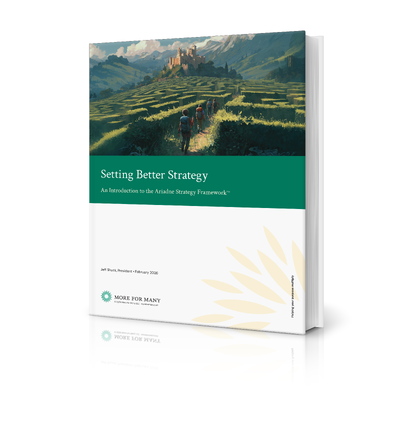
Setting Better Strategy is our free guide to the Ariadne Strategy Framework. The three layers of Identity, Focus, and Execution will build on what your Landscape Analysis surfaced.
Author
About More For Many
We help purpose-driven organizations uncover opportunities, find audiences, spread ideas, and grow impact. Strategy, insight, and inspiration for a generous world.
From Our Blog
Stay up to date with what is new in our industry, learn more about the upcoming products and events.

We Are Only Limited By Our Creativity

The People Behind the Numbers: Part 2 of the P2P Top 30 Data Deep Dive