We Know There's A Problem, We Just Don't Know Which One
Last fall, my wife and I hosted weekly football watch parties for our kids and their friends. It’s a pretty thankless job being an Indianapolis Colts fan, so we cushioned the blow with home-cooked meals each week, based on requests from whoever was attending. Chili one week, wings the next, usually served with a frustrating Colts loss as a consistent side dish.
Alas, as the season went along, the food got better, and the football got worse.
Invariably, by the fourth quarter, the complaining and diagnosis would start. “Our defense is SO bad,” someone would begin. “We can’t stop ANYTHING.”
Someone else would offer an alternative opinion. “Our defense isn’t really the problem,” they would say. “We need a quarterback who is younger than 40.”
“True,” a third would chime in. “But the consistent issue is management.”
We could all agree on the problem: The Colts were losing. But even after spending arguably too much of our time watching it play out week after week, none of us could agree on the reasons why.
When No One Agrees on the Cause
Ah, football! I bring this up not only because I’m already ready for the next season (hope springs eternal), but because it’s a great example of something I see all the time in my strategic planning work.
Increasingly this year, I’m being asked to help complete strategic plans that were either started using another tool and have major gaps, or to repair, revise, or overhaul plans that were completed but failed to deliver on their promise.
In nearly every case, I find that the plans didn’t fail because they were poorly executed. They failed because the team never agreed on the problem in the first place.
A lot of organizational meetings follow the same pattern as the Sunday football complaints. You’ve probably been in this meeting: the development team thinks it’s a brand awareness problem. The marketing team is sure it is a constituent engagement problem. The executive director thinks it’s a resource issue, and the board chair is concerned the organization has a funding diversification problem.
Four competent people, looking at the same organization, all correct on the symptoms but misaligned about the cause.
In most situations like this, competent people want to drive to action, so in the rush to come up with solutions, they shortchange time to get on the same page about what the problem actually is.
And so, the resulting plan aims to address all the symptoms at once. Imperatives and initiatives pile up — a mishmash that adds to everyone’s workload but doesn’t connect to growth. Six months later, the document is sitting on a shared drive nobody opens.
You Can’t Execute Your Way Out of a Diagnostic Problem
Just like throwing a great rookie quarterback in a bad system won’t get you any better results, great solutions focused on the wrong problems usually create new problems of their own.
So what do you do?
What helps are slower, more thoughtful questions. Gathering your team together for an hour-long conversation starting with a simple question – “How do you see it?” – can work wonders.
But even better is a more thoughtful, intentional set of questions that takes you through your landscape step by step: What’s actually true about our internal capacity right now? What’s happening in our environment that we’re not talking about? What’s on the horizon we haven’t prepared for?
The Place To Start
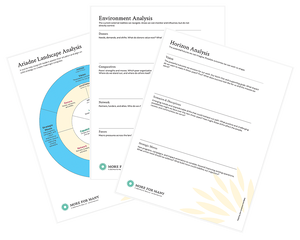
Asking those kinds of questions, especially in a room of intelligent, well-meaning but strong-willed people, isn’t always easy. So, we built the Ariadne Landscape Analysis to help.
It’s a structured way for your board, leadership, and staff to look at the same questions, surface where you agree and where you don’t, and discover what you’ve been missing.
And humbly, I’d say it’s way better than SWOT analysis and one thousand times better than assuming everyone sees things the same way.
We published it this month as the latest piece in our Deep Dive exploration series, together with a companion free download with worksheets you can use in your next meeting.
Read the full piece here → moreformany.com/beyond-swot-landscape-analysis
The Colts, sadly, are on their own.





No Comments Yet
Let us know what you think